


When a Sewer Problem Hits in Uptown, Chicago: Repair or Replace?
Deciding between spot repair vs full replacement sewer Uptown comes down to one thing: how much of your pipe is actually damaged.
Here’s a quick answer:
| Situation | Best Option |
|---|---|
| Single crack or isolated root intrusion | Spot repair |
| One damaged section, rest of pipe healthy | Spot repair or partial replacement |
| Multiple breaks, collapsed pipe, or pipe over 40 to 50 years old | Full replacement |
| Recurring backups after previous repairs | Full replacement |
| Clay or cast iron pipe with widespread deterioration | Full replacement |
The golden rule: always get a camera inspection first. It’s the only reliable way to know what you’re actually dealing with.
Uptown is one of Chicago’s older, denser neighborhoods. Many homes here still have original clay or cast iron sewer lines installed before 1970. Chicago’s freeze-thaw cycles, mature tree canopy, and heavy summer storms all put extra stress on those aging pipes. A problem that looks minor on the surface can run much deeper underground.
Delaying a repair, even a small one, can lead to major property damage and a much more disruptive repair.
At Baethke Plumbing, our licensed team has spent decades helping Chicago homeowners navigate decisions around spot repair vs full replacement for sewer lines in Uptown and across the greater Chicago area. We handle everything from isolated pipe patches to full lateral replacements, and we always start with an honest camera inspection before recommending any work.
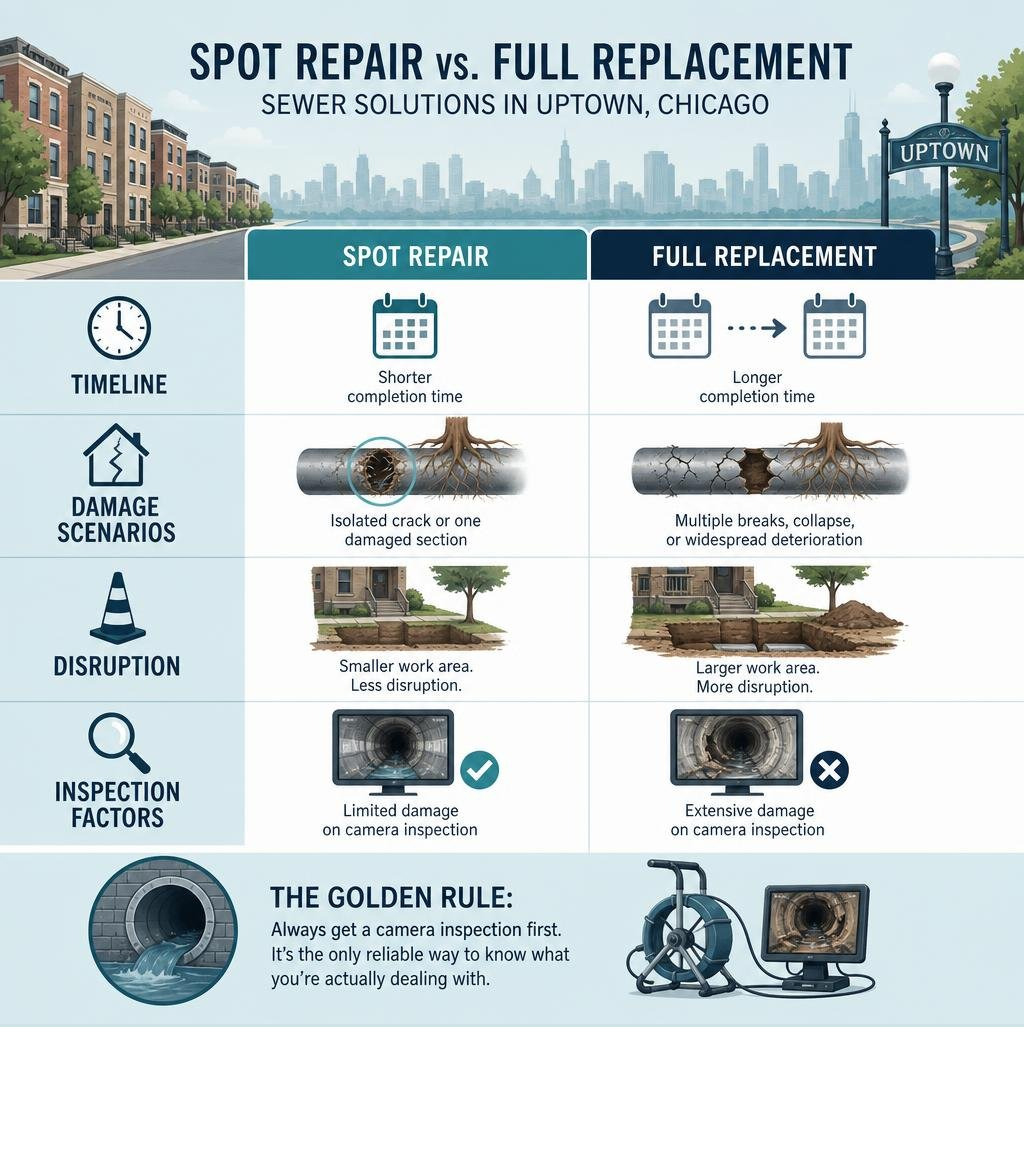
Spot repair vs full replacement sewer Uptown: key differences
When we talk about resolving main line issues, we generally look at two main paths: targeting a single, isolated problem section or overhauling the entire run. Deciding between a localized patch and a complete system upgrade is a major decision for any Uptown property owner.
A spot repair focuses on fixing a specific, isolated section of the sewer pipe. If a camera inspection shows that most of your sewer lateral is structurally sound, stable, and clear, but a single tree root has cracked a joint or a fence post accidentally punctured a section, we can perform a targeted fix. This is highly efficient and keeps your project focused on the actual damaged area.
For homeowners who want to understand how local pipe condition affects this decision, our sewer line repair service explains how Baethke Plumbing evaluates sewer laterals, identifies the damaged section, and recommends a practical repair path for Chicago properties.
Conversely, a full replacement involves replacing the entire length of the sewer line from your building’s foundation all the way to the city main connection. If the pipe material is systemically failing, such as cast iron suffering from extreme channel rot or clay pipes that have fractured in multiple areas, patching one spot won’t save you from another backup next month. In these scenarios, complete replacement is the only way to protect your property long-term.
For a broader planning perspective, our sewer line repair vs replacement guide walks through the repair-versus-replacement decision, while our main sewer line repair options article explains the practical differences between traditional excavation, trenchless methods, and targeted repairs.
When to choose spot repair vs full replacement sewer Uptown
Spot repairs are highly effective under the right circumstances. We typically recommend a spot repair when:
- The damage is highly localized: A camera inspection reveals a single, isolated crack or a single joint compromised by tree roots, while the rest of the line is clean and structurally solid.
- The pipe material is modern and durable: If your home has a newer Schedule 40 PVC sewer line that was damaged by a specific external event, like yard digging or a shifting heavy object, a spot repair is a permanent, reliable solution.
- The pipeline maintains a proper slope: If the overall line is correctly pitched and doesn’t suffer from sagging or “bellies” that collect standing water, patching the damaged area will restore proper flow.
When full replacement is the only option
There are times when attempting a spot repair is like putting a small adhesive bandage on a major structural leak. We advise a full sewer replacement when:
- The pipe material is past its prime: Older clay or cast-iron lines that have reached 50 to 100 years of age often suffer from systemic decay. Clay becomes brittle and cracks under soil pressure, while cast iron experiences severe internal rusting and channel rot.
- The pipe has collapsed or shifted severely: If sections of the pipe have completely pancaked or offset by more than 30% of the pipe’s diameter, a simple patch cannot restore structural integrity.
- There are multiple problem areas: If we find root intrusion at several different joints along the run, repairing each spot individually may become less practical than replacing the entire line once.
Local Uptown conditions and diagnostic warning signs

Uptown Chicago has a distinct architectural and geographical character. From the historic multi-family brick buildings near the lakefront to the tree-lined streets of the Sheridan Park historic district, local conditions play a massive role in how sewer lines age.
First, Chicago’s intense freeze-thaw cycles cause the ground to shift significantly every winter and spring. This movement puts immense physical stress on rigid, older pipe materials like clay. Second, Uptown is known for its beautiful, mature oak, maple, and elm trees. While these trees provide wonderful shade, their root systems are constantly searching for moisture, making older clay pipe joints an easy target. When roots find a microscopic seam, they force their way in, expanding and eventually shattering the pipe.
Additionally, local soil composition and heavy seasonal rains can saturate the ground, putting external pressure on weak sewer lines. To navigate these unique local challenges safely, Baethke Plumbing uses camera inspection, location-specific diagnosis, and repair recommendations based on the actual condition of the private sewer lateral.
For larger multi-family or business properties in Uptown, our commercial sewer line repair service supports the same diagnostic approach while accounting for higher fixture loads, tenant disruption, and access constraints common in Chicago buildings.
Chicago infrastructure and private drain program
In Chicago, homeowners are responsible for the maintenance and repair of their entire “private drain” (the sewer lateral). This responsibility extends from the home’s plumbing all the way to where it connects to the city-owned main sewer line, even if that connection lies deep beneath the public street or parkway. The City of Chicago’s private drain program explains how private-drain issues are handled locally, which is why a licensed diagnosis matters before deciding how much pipe to repair or replace.
Because Chicago municipal code places the burden of under-street excavation on the property owner, a sewer line failure under the public right-of-way can quickly become expensive due to city permitting, street-cutting, and restoration requirements. This is why diagnosing the exact location and extent of the damage early is so critical.
Warning signs of sewer line failure
Your sewer line rarely fails without warning. Keep an eye out for these common red flags:
- Multiple slow-draining fixtures: If only your kitchen sink is slow, it’s a local clog. If your basement floor drain, toilet, and shower are all draining slowly or backing up simultaneously, the issue is in the main sewer lateral.
- Persistent sewage odors: A strong sewer gas smell in your basement or yard indicates a crack or break in the line.
- Unusually lush, green patches of grass: If a strip of your lawn is suddenly much greener and faster-growing than the rest of the yard, it may be fertilized by escaping sewage from a cracked line.
- Gurgling sounds: Toilets or drains that make gurgling noises when water is running elsewhere in the home indicate trapped sewer gas caused by a partial blockage.
Diagnostic steps for spot repair vs full replacement sewer Uptown
To determine the absolute best course of action for your property, we follow a rigorous diagnostic process:
- Sewer camera inspection: We run a high-definition fiber-optic camera through your sewer line. This allows us to see the exact pipe material, locate cracks, identify root blockages, and assess the overall structural integrity of the pipe without digging up your yard.
- Slope and belly assessment: We evaluate whether the pipe has settled or sagged, forming a “belly.” Pipes must maintain a continuous downward slope to function correctly.
- Integrity evaluation: We check if the pipe is still round and structurally sound, or if it is starting to collapse or ovalize.
For a detailed look at common repair paths, our pros and cons of sewer line repair methods breakdown explains how different methods perform in real-world homes, while our Chicago sewer line repair homeowner guide covers warning signs, local repair considerations, and the next steps after an inspection.
Comparing costs, timelines, and disruption levels
Understanding the financial and lifestyle impacts of each option is crucial before scheduling work. Below is a realistic comparison of what Uptown homeowners can expect in the local Chicago market:
| Feature | Spot Repair | Full Replacement |
|---|---|---|
| Average Cost Range | Lower, because work is limited to one damaged section | Higher, because the full run and restoration may be involved |
| Project Timeline | Often shorter | Usually longer |
| Disruption Level | Low to Moderate, targeted area | High, extensive digging or lining |
| Yard/Property Restoration | Minimal landscaping repair needed | Significant landscaping or concrete restoration |
| Expected Lifespan | Varies based on remaining pipe age | Long-term service life with modern PVC or HDPE |
Trenchless vs. traditional excavation methods
The method used to execute your repair or replacement plays a massive role in both the final cost and the disruption to your property.
- Traditional open-trench excavation: This involves digging a trench along the path of the sewer line to physically remove and replace the old pipe. While traditional excavation is highly reliable and sometimes the only option for collapsed or severely misaligned pipes, it can cause significant disruption to yards, driveways, and sidewalks.
- Trenchless sewer repair, CIPP lining: Cured-in-Place Pipe lining is a modern “no-dig” technology. We insert an epoxy-saturated sleeve into the existing pipe, inflate it, and let it cure. This creates a seamless, root-resistant “pipe within a pipe” that can last for decades. It preserves your landscaping and can reduce labor and restoration needs.
- Pipe bursting: Another trenchless method where a new high-density polyethylene, or HDPE, pipe is pulled directly through the old pipe, fracturing the old pipe outward while instantly replacing it.
Insurance coverage and warranties
A common question we hear is whether homeowners insurance will cover these major expenses.
Standard homeowners insurance policies typically exclude sewer line damage caused by gradual wear and tear, age, or root intrusion. This means that if your older clay pipe finally gives out, the repair is usually an out-of-pocket expense. However, if the damage was caused by a sudden, accidental event, such as a tree falling and crushing the line or a utility crew damaging it, you might be covered.
Many Chicago homeowners opt to add a service line endorsement to their insurance policy. This optional coverage may help with repairs or replacements of underground utility lines, including water and sewer, depending on the policy language.
Additionally, work performed by licensed professionals like the Baethke Plumbing team comes with robust warranties. While spot repairs generally carry limited warranties on the patched section, a full replacement using modern Schedule 40 PVC or HDPE pipe often comes with long-term manufacturer warranties. Your technician can explain which warranties apply to the specific material and repair method used at your property.
Frequently asked questions about sewer repairs in Uptown
Does homeowners insurance cover sewer line replacement in Chicago?
In most cases, standard homeowners policies do not cover sewer line replacement if the damage is due to normal wear and tear, pipe age, or tree root intrusion. However, if you have a specific “service line endorsement” on your policy, or if the damage was caused by a sudden, accidental external force, you may have coverage. We always recommend reviewing your policy details with your insurance agent.
How long do trenchless sewer repairs last?
Trenchless sewer repairs, such as CIPP, or Cured-in-Place Pipe, lining are durable. The epoxy liners we use are designed for long-term performance. If we use pipe bursting to pull a new HDPE, or High-Density Polyethylene, pipe through, that material is also designed for long service life. Both options are seamless, making them highly resistant to future root intrusion.
Can a collapsed sewer line be fixed with spot repair?
No, a fully collapsed or “pancaked” sewer line cannot be fixed with a simple spot repair or trenchless lining. Trenchless lining requires an intact pipe structure to act as a mold for the liner. If the pipe has collapsed, we must perform a traditional excavation to remove the collapsed section. In some cases, we can perform a hybrid repair: excavating and replacing the collapsed section, and then lining the rest of the structurally sound pipe.
Conclusion
When you are facing a sewer issue, making the right choice between spot repair vs full replacement sewer Uptown is the key to protecting both your home and your bank account. While a targeted spot repair is a strong, budget-conscious fix for isolated damage, an aging or systemically failing pipe system requires a full replacement to prevent recurring emergencies.
At Baethke Plumbing, we have served Chicago homeowners for over 30 years with licensed expertise, straightforward pricing, and a customer-first approach. We don’t believe in one-size-fits-all solutions. Our team will perform a thorough, high-definition camera inspection, show you exactly what is happening inside your sewer line, and help you choose the most reliable, cost-effective solution for your property.
Don’t wait for a minor drain backup to turn into an expensive emergency. Contact Baethke Plumbing today to contact our professional sewer line repair technicians or request a comprehensive camera inspection of your Uptown home. We are here to keep your plumbing flowing smoothly!


