


Deciding to repipe your Chicago home comes with two big unknowns: which material actually holds up, and what the project will realistically cost you. With so many piping options marketed as “modern” and “affordable,” it’s easy to end up confused, or worse, sold on a product that isn’t even legal to install where you live.
At Baethke Plumbing, we’ve repiped thousands of homes across every corner of Chicago, from century-old bungalows to modern high-rises, and we know exactly what holds up long-term and what doesn’t.
In this article, we’ll summarize the real cost to repipe your home, clear up the PEX versus copper debate once and for all, and walk you through the hidden costs Chicago homeowners most often run into, so you can move forward with a clear, accurate picture of what your project actually involves.
Copper and PEX: Differences Explained
Copper is a rigid metal pipe, while PEX (cross-linked polyethylene) is a flexible plastic pipe. Copper costs more and takes longer to install because every joint must be soldered, but it can last 50 years or more and holds up well to heat and sunlight.
PEX is more affordable and faster to install, since it bends around corners with fewer fittings. However, it can’t be exposed to sunlight, doesn’t perform well in sub-zero temperatures, and has a shorter track record than copper.
PEX Is Not Legal in Chicago for Repiping
Let’s get this out of the way immediately, because it comes up constantly: PEX piping is not legal for use inside the city of Chicago. It never has been. This isn’t a case of a product that used to be approved and later got banned. Chicago has simply never permitted it.
However, PEX is legal in the broader state of Illinois, so if you live in one of the suburbs, you may have encountered contractors offering it as an option. But within Chicago’s city limits, it’s off the table entirely, and honestly, even where it is legal, it’s not a product Baethke recommends. If a plumber offers PEX (where it is legal), we would strongly urge you to go with copper in your plumbing system.
Why Baethke Does Not Recommend PEX, Even Where It’s Allowed
Since it entered the market, it has gone through repeated iterations and redesigns, largely in response to significant failures. This is not a great quality for a product meant to sit inside your walls for decades, out of sight and easy to forget about until something goes wrong.
There’s also a growing body of evidence around plastic leaching into water that travels through plastic piping. Given everything we already know about plastic exposure in daily life, most homeowners aren’t eager to add “my own water line” to the list of sources.
Between the failure history and the water-quality concerns, PEX simply doesn’t inspire the kind of confidence you want in a whole-home water supply system.
Legality aside, PEX has a track record that does not give us enough confidence to use it in your home.
Should You Use CPVC to Repipe Your Chicago Home?
CPVC is the other alternative you’ll sometimes see mentioned. It’s a rigid white plastic piping, similar in appearance to plastic drain lines, but rated for potable water use. It is legal in Chicago, and it does have its fans.
We’re not among them.
CPVC’s biggest weakness is that it becomes brittle over time. It tends to perform fine for the first several years. After about 10 years, it can turn fragile enough that a hard knock, an accidental impact during other work, or a shifting foundation can cause it to snap outright.
A snapped water line isn’t a slow leak you can catch early. It’s a sudden, catastrophic failure. Copper, by contrast, might bend under stress, but it isn’t going to suddenly crack open and flood your home.
Why Copper Remains the “Gold” Standard for Pipes
Copper has been used in residential plumbing for over a century, and it has earned its reputation the hard way, through decades of real-world performance. It’s the safest option, the most durable, and the longest-lasting material available for potable water lines. Period.
This is exactly why, at Baethke Plumbing, copper is the only material we install for a customer’s home water supply. It’s not a matter of preference or tradition for tradition’s sake. It comes down to product failure rates, safety, and simple longevity.
When we’re routing water lines that will sit sealed inside your walls for the next 50-plus years, we want a material with a track record that has actually earned that kind of trust.
Baethke Plumbing Repiping Material Recommendations Overview
| Material | Chicago Legality | Baethke Recommendation | Key Characteristics & Risks |
| Copper | Legal | Highly Recommended (Exclusive choice) | Safest, most durable, and longest-lasting material available. Proven century-long track record of real-world performance. Bends under stress instead of snapping. |
| CPVC | Legal | Not Recommended | Rigid plastic piping that becomes brittle after about 10 years. High risk of cracking or snapping from minor impacts or settling, causing sudden, catastrophic flooding. |
| PEX | Illegal (Inside city limits) | Not Recommended (Even where legal) | Never permitted in Chicago city limits. History of product failures and repeated redesigns. Raises water-quality concerns due to potential plastic leaching. |
What Does a Repipe in Chicago Actually Cost?
Here’s the part everyone actually wants to know, and the honest answer is: it depends heavily on your home’s layout and finish level.
For the simplest scenario, a single-story ranch home with an unfinished basement, a repipe is a relatively contained job. Since the plumbing contractor has open access to the pipes without needing to cut into finished walls or ceilings, costs typically will land somewhere in the range of $5,000 to $10,000.
On the other end of the spectrum, a two- or three-story home that’s finished from top to bottom is a much bigger undertaking. That means opening finished basement ceilings and walls, opening walls on the first floor, and potentially cutting into tiled walls on upper floors to reach bathroom plumbing. In a home like this, you could be looking at $25,000 to $30,000 for a complete repipe.

The difference between those two numbers isn’t really about the pipe itself. It’s about how much finished material has to be opened up, and eventually repaired, to get to it.
-
Is Copper Installation Labor Really More Expensive?
You might assume copper costs more to install simply because it’s copper, but that’s actually a bit of a myth today. Historically, that assumption held more truth: before press fittings became code-approved in Chicago, every copper joint had to be soldered, which was a slow, labor-intensive process.
Modern installation methods rely on press fittings instead, which have brought copper’s labor time down significantly. As a result, labor costs for copper are now largely comparable to installing PEX or CPVC. The material itself carries a higher price tag than plastic alternatives, but the labor gap that used to exist has mostly closed.
-
The Hidden Costs You Don’t See Coming
Ask any licensed plumbing contractor who has done dozens of repipes, and they’ll tell you the same thing: the water lines are rarely the only surprise.
The most common hidden cost shows up when a plumber exposes the water supply lines and discovers that the waste and vent piping running through the same walls is of similar age and condition. Since everything is already opened up, it usually doesn’t make sense to seal the walls back up without addressing that plumbing too. It’s far more cost-effective to handle it now than to reopen the same wall again in a few years. This single issue is, by a wide margin, the most frequent hidden cost homeowners run into during a repipe.
Electrical surprises are another common find. Old, buried junction boxes turn up more often than you’d expect, and when they do, work has to stop. You can’t legally pull new wire through or work around an improperly housed junction box, so at that point, an electrician needs to get involved before the walls can be closed back up. Some homeowners choose to address it immediately; others choose to defer it. Either way, it’s a real cost consideration that often isn’t part of the original estimate.
-
Chicago-Specific Repiping Wrinkle: Concrete-Encased Water Lines
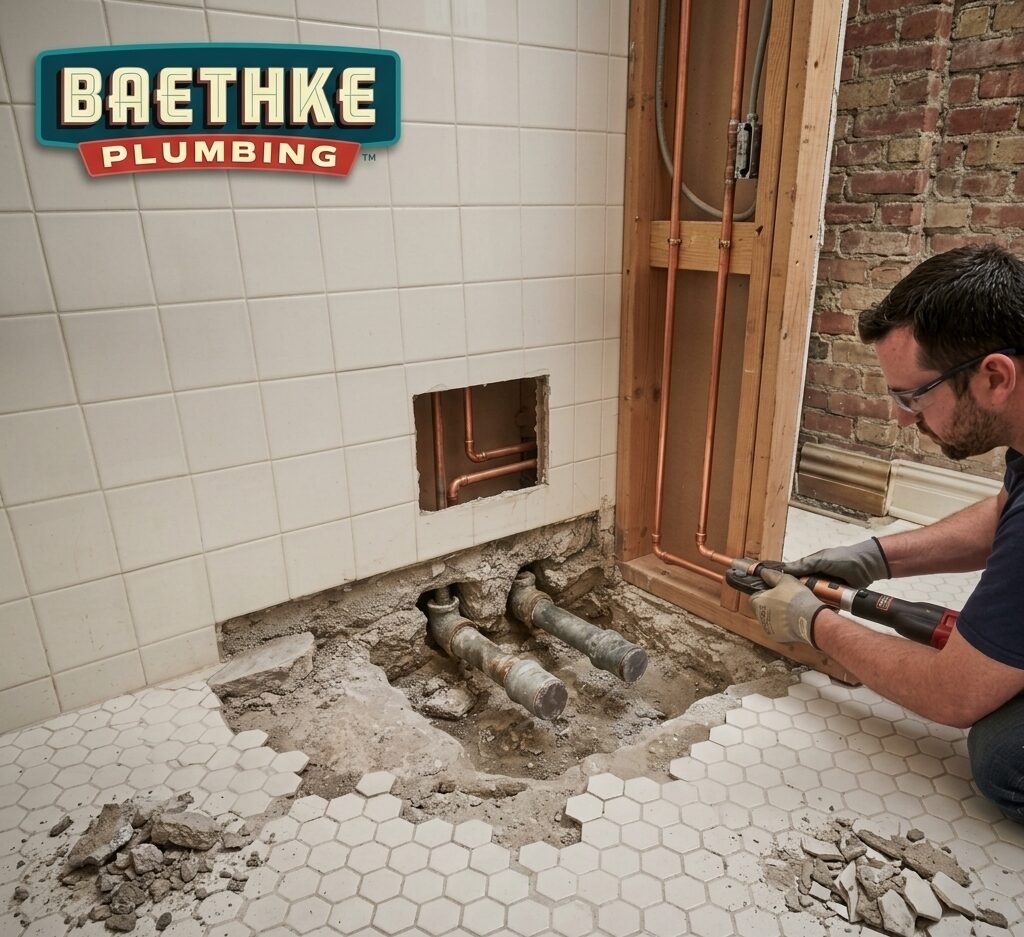
Here’s one type of cost uniquely tied to Chicago’s architectural history. In homes built roughly between the early 1900s and the 1950s, it was common practice to pour bathroom floors with about two inches of concrete, and to run the original water lines directly inside that concrete slab.
Naturally, you can’t simply run new lines back through the exact same path; that concrete has to be worked around, not through. This means the plumbing essentially has to be re-engineered to route around the original concrete-encased lines, which adds both complexity and cost to a repipe in one of these older Chicago homes.
What to Know Before You Repipe Your Chicago Home
Repiping your Chicago home comes down to a few key facts: PEX isn’t legal within city limits and carries a troubling failure history even where it is allowed, CPVC becomes brittle and prone to sudden, catastrophic failure over time, and copper remains the safest, most durable, and longest-proven material for the job.
Costs vary widely depending on your home’s layout, from around $5,000 to $10,000 for a simple unfinished-basement ranch, up to $25,000 to $30,000 for a fully finished multi-story home, and modern press-fitting methods have made copper’s labor costs far more comparable to plastic alternatives than they once were.
Just as important, homeowners should go in expecting hidden costs like aging waste and vent lines, buried electrical junction boxes, or, in older Chicago homes, water lines originally poured into concrete bathroom floors.
Understanding these factors ahead of time is what separates a stressful repipe from a smooth, well-planned one. If you’re ready to get an accurate cost estimate and expert guidance for your home, contact Baethke Plumbing today to schedule your repipe consultation.
