


That Drip Is Costing You — Here’s How to Fix a Leaking Shower Faucet
To fix a leaking shower faucet, follow these key steps:
- Turn off the water supply to the shower or whole house
- Identify your faucet type — single-handle (cartridge) or two-handle (compression)
- Remove the handle, cap, and escutcheon plate
- Replace the worn part — cartridge, washer, O-ring, or stem
- Reassemble all parts in reverse order
- Turn the water back on and test for leaks
That steady drip from your shower faucet is more than annoying. It wastes water, raises your utility bill, and, if ignored, can eventually cause water damage in your bathroom walls and flooring.
The cause is almost always one of a few common culprits: a worn-out cartridge, a cracked rubber washer, a bad O-ring, or mineral buildup restricting water flow. Once you know which type of faucet you have, the repair becomes straightforward.
At Baethke Plumbing, we’ve helped homeowners across the Greater Chicago area deal with all kinds of leaking shower faucets. In this guide, you’ll learn how to fix a leaking shower faucet yourself – and how to tell when the repair is better left to a professional.
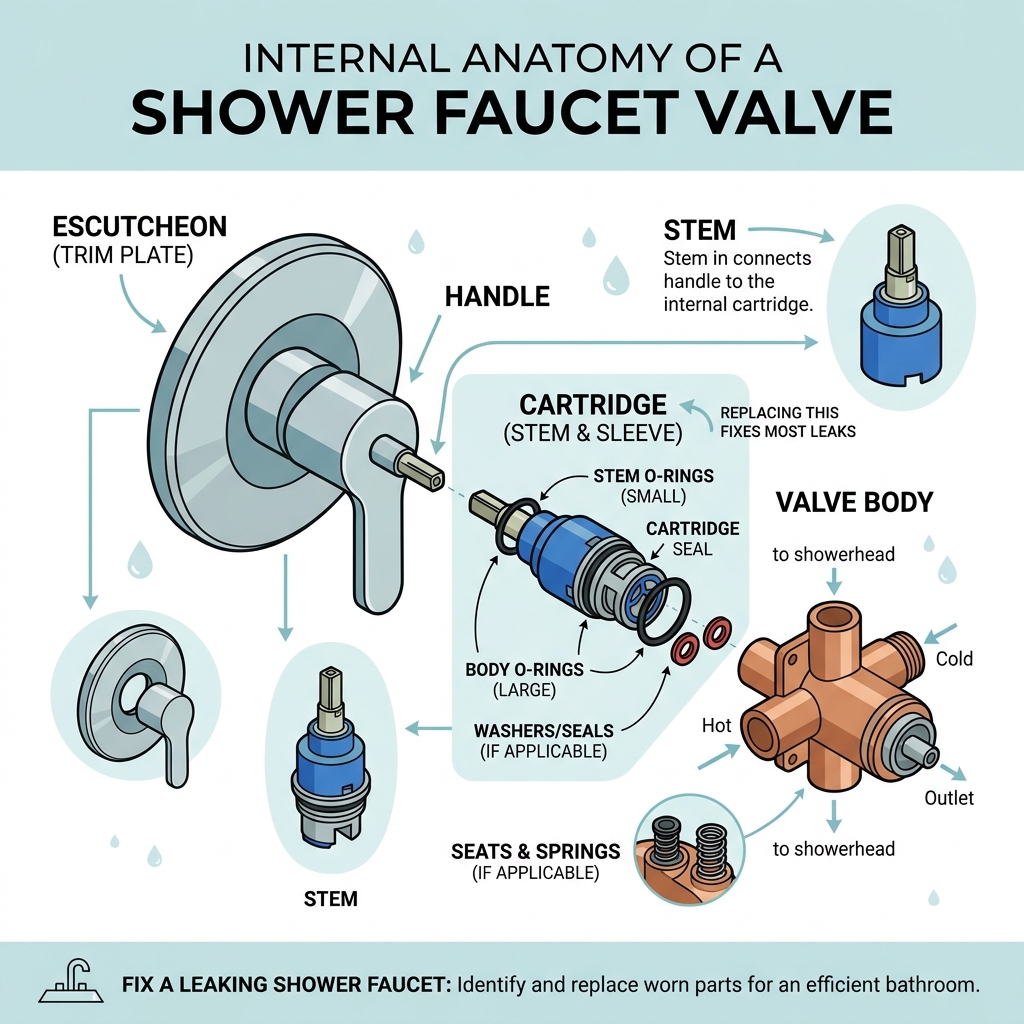
Common Causes and Tools to Fix Leaking Shower Faucet
Before we roll up our sleeves, we need to understand what we’re fighting. In our decades of experience serving Chicago neighborhoods from Lincoln Park to Edison Park, we’ve found that most leaks boil down to a few mechanical failures.
What’s Causing the Drip?
- Worn-out Cartridge: In single-handle faucets, the cartridge is the “brain” that regulates flow. Over time, the plastic or ceramic internals wear down.
- Failed Washers and O-rings: These small rubber components create the watertight seals. Heat and friction eventually cause them to harden, crack, or flatten.
- Mineral Buildup: Chicago water can be hard. Calcium and magnesium deposits can coat the valve seats, preventing a clean seal.
- Corroded Valve Seats: If a leak is ignored, the constant flow of water can “wire-draw” or erode the metal seat where the washer rests.
- High Water Pressure: If your home’s pressure is over 80 PSI, it can force water past even brand-new seals.
Your DIY Toolkit
You don’t need a truck full of industrial gear to fix leaking shower faucet issues. Most of these items are likely already in your junk drawer or garage:
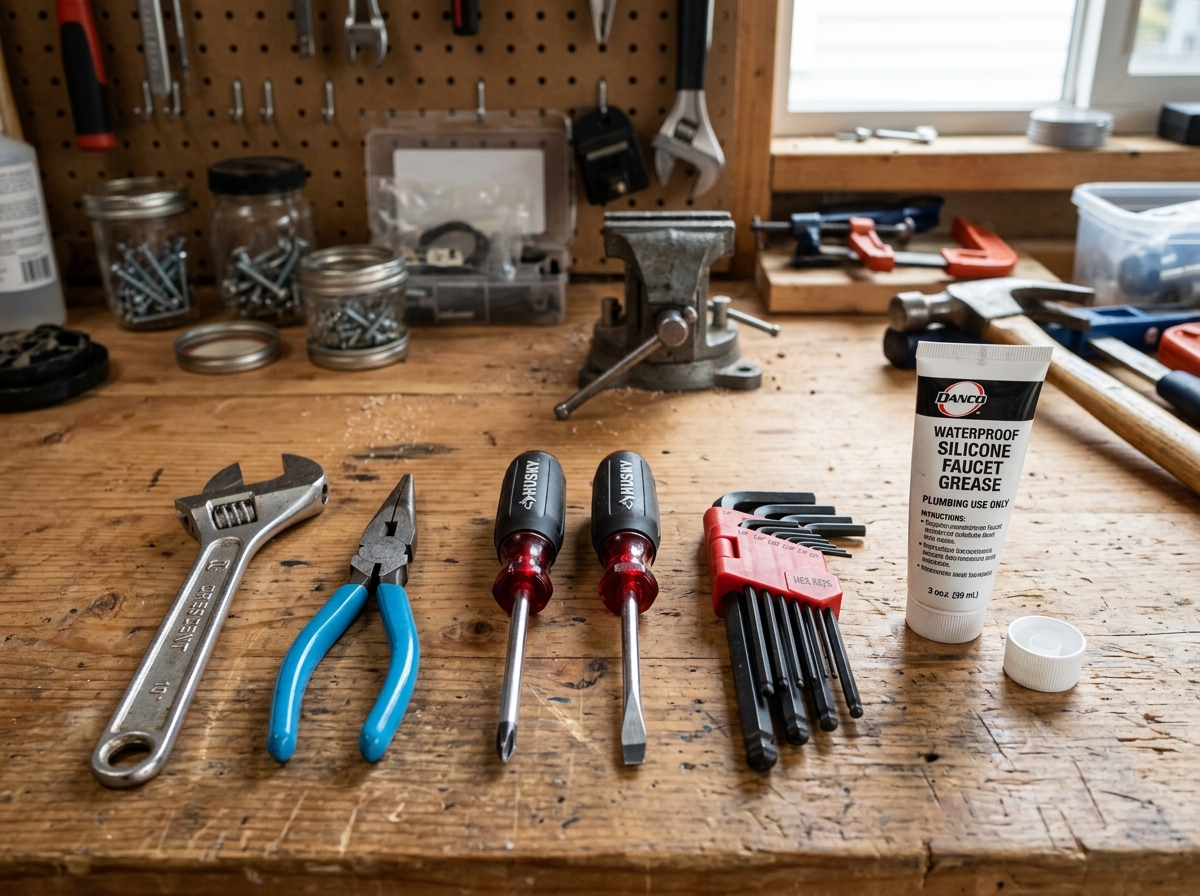
- Screwdrivers: Both Phillips and flat-head for handle screws.
- Adjustable Wrench: To loosen the large nuts holding the stem or cartridge.
- Needle-nose Pliers: Essential for pulling out small clips or old O-rings.
- Allen Wrench Set: Many modern handles are held on by a tiny “set screw” that requires a hex key.
- Silicone Faucet Grease: This is crucial! Never use petroleum jelly; it degrades rubber.
- Teflon Tape (Plumber’s Tape): For sealing threaded connections.
- Replacement Parts: We recommend taking your old parts to the hardware store to ensure an exact match.
Preparation: Safety and Water Shut-Off
We cannot stress this enough: Do not start unscrewing things until the water is off. If you pull a cartridge while the line is live, you’ll turn your bathroom into a localized version of the Buckingham Fountain.
Locating the Shut-Off
In many Chicago homes, especially older bungalows in Albany Park or Jefferson Park, there might not be a dedicated shut-off behind the shower wall. If you don’t see an access panel in the room behind the shower, you’ll need to head to the basement or utility closet to turn off the main water valve for the entire house.
Step-by-Step Prep
- Close the Valve: Turn the handle clockwise until it stops.
- Release Pressure: Open the shower faucet and a sink faucet nearby to drain the remaining water in the lines.
- Protect the Drain: This is a pro tip we give all our DIY friends. Cover the shower drain with a rag or towel. There is nothing more frustrating than watching a tiny, irreplaceable screw bounce off the tub and disappear down the drain.
- Protect the Tub: Lay a heavy towel down on the shower floor. This prevents dropped tools from chipping your porcelain or acrylic finish.
By saving water by detecting and fixing leaks, you’re doing your wallet and the environment a favor.
Step-by-Step Guide for Different Faucet Types
Not all showers are created equal. To fix a leaking shower faucet, you first need to know which “species” you’re dealing with.
| Faucet Type | Handle Count | Internal Mechanism | Common Failure |
|---|---|---|---|
| Cartridge | Usually 1 | Plastic/Brass Cylinder | Internal seals or O-rings |
| Compression | Usually 2 or 3 | Threaded Brass Stem | Rubber washer at the base |
| Ball/Disc | Usually 1 | Metal Ball or Ceramic Disc | Springs and rubber “seats” |
Identifying your faucet brand is half the battle. Check the escutcheon plate, the metal trim against the wall, for a logo or name. If you cannot find one, the internal part often has a model number. If tracking down the right replacement part feels like too much, faucet replacement may be the better long-term fix.
Replacing a Cartridge to Fix Leaking Shower Faucet
Most modern single-handle showers use a cartridge. If you have a Moen or Delta shower, this is likely what you’ll find.
- Remove the Handle: Pop off the decorative cap and unscrew the center screw. If it’s a lever handle, look for a set screw underneath.
- Remove the Trim: Unscrew the escutcheon plate. You may need to cut the caulk around the edge with a utility knife first.
- Pull the Clip: Many cartridges are held in by a U-shaped metal locking clip. Use your needle-nose pliers to pull this straight up.
- Extract the Cartridge: Sometimes they slide out easily. If it’s stuck due to mineral buildup, you may need a “cartridge puller” tool.
- Clean the Valve Body: Use an old toothbrush and white vinegar to scrub out any grit inside the brass valve.
- Lube and Install: Apply silicone grease to the new cartridge’s rubber seals. Slide it in, making sure the “Hot/Cold” tabs are oriented correctly.
- Reassemble: Put the clip, trim, and handle back on.
For more specific shower repair tips, always check your manufacturer’s website.
Replacing Washers and Stems to Fix Leaking Shower Faucet
If you have separate handles for hot and cold, you likely have a compression faucet. These are very common in the historic homes of Logan Square and Andersonville.
- Disassemble the Handles: Remove the caps and screws. Pull the handles off.
- Unscrew the Stem: Use a wrench or a deep socket (shower valve socket) to unscrew the large hex nut holding the stem in place.
- Check the Washer: At the very bottom of the stem, you’ll see a rubber washer held on by a brass screw. If it’s flattened or shredded, that’s your leak!
- Check the Seat: Look inside the valve with a flashlight. The “seat” is the metal circle the washer presses against. If it’s pitted or scratched, a new washer won’t help. You’ll need to replace the seat using a seat wrench.
- Replace O-rings: There is usually an O-ring on the stem body that prevents water from leaking out behind the handle. Replace this and apply grease.
- Reinstall: Screw the stem back in, but don’t over-tighten! You only need it snug enough to stop the leak.
This type of faucet repair is a classic weekend project that can save you a bundle.
Testing Your Repair and Troubleshooting Persistent Leaks
Once everything is back together, it’s time for the moment of truth.
- Slow and Steady: Turn the water back on at the main valve slowly.
- Flush the Air: Open the shower faucet. You’ll hear some coughing and sputtering as the air leaves the pipes. Let it run for a minute.
- The Dry Test: Turn the shower off. Dry everything—the spout, the handles, and the wall—with a towel.
- Wait and Watch: Sit tight for 15 minutes. If you see a bead of water forming at the spout, the seal isn’t tight. If water is seeping from behind the handle, an O-ring might be pinched or the packing nut is loose.
What if it Still Leaks?
If you’ve replaced the cartridge and it still drips, you might have a high-pressure issue. In some Chicago neighborhoods, water pressure can fluctuate. We recommend buying a $10 pressure gauge that screws onto an outside hose bib. If your pressure is above 80 PSI, you may need a Pressure Reducing Valve (PRV) or an expansion tank on your water heater to absorb thermal expansion.
Frequently Asked Questions about Shower Leaks
How do I identify my faucet brand for replacement parts?
The easiest way is to look for a logo on the handle or the plate. If that’s missing, take the old cartridge or stem with you to a local hardware store. Most stores have a “stem identification” chart or a gauge where you can match the length and spline count (the teeth on the end of the stem). You can also use mobile apps that allow you to take a photo of the part to identify the brand automatically.
When should I call a professional plumber?
DIY is great, but sometimes the job fights back. You should call us if:
- The Screw is Stripped: If you can’t get the handle off because the screw is corroded.
- The Valve is Cracked: If you see water dripping inside the wall.
- The Parts are Stuck: If the cartridge won’t budge even with a puller, forcing it can break the pipes behind the wall.
- Persistent Leaks: If you’ve replaced the parts twice and it’s still dripping.
Check out these signs you need to call a professional Chicago plumber for more details.
How often should I perform maintenance to prevent leaks?
We recommend a quick “shower physical” once a year.
- Vinegar Soak: If your showerhead is spraying sideways, unscrew it and soak it in white vinegar overnight to dissolve calcium.
- Check the Caulk: Ensure the seal around the escutcheon plate is intact so water doesn’t get behind the wall.
- Handle Feel: If the handle feels “gritty” or hard to turn, it’s time to pull the cartridge and apply fresh silicone grease before the seals tear.
Conclusion
A leaking shower doesn’t have to be a permanent fixture in your home. With a little patience and the right steps, you can fix a leaking shower faucet and get back to enjoying a peaceful, drip-free bathroom.
However, we know that life in Chicago is busy. Whether you’re in Ravenswood, River North, or Oak Park, you might not have the two hours to spend wrestling with a stuck valve. That’s where Baethke Plumbing comes in. With over 30 years of expertise and a team of licensed pros, we offer straightforward pricing and customer-first service to get your plumbing back in tip-top shape.
Don’t let your money go down the drain. Contact our plumbing experts to schedule your professional shower repair today and let us handle the heavy lifting!